The upcoming Year of the Ocean, which will culminate in the United Nations Conference on the Oceans in Nice in June 2025 (UNOC3), is an opportunity to step up the international community’s ambitions to protect marine biodiversity. This ambition is part of the Principality of Monaco’s long-standing commitment to the Mediterranean, as demonstrated by the actions of the Monaco Oceanographic Institute and the Monaco Explorations, which have made this a central issue for the period 2025-2030. Within the Mediterranean Action Plan (MAP) of the United Nations Environment Programme (UNEP), and with the current revision of the Mediterranean Strategy for Sustainable Development (MSSD 2026-2035), the Blue Plan is also at the forefront in helping the States of the Mediterranean Basin to better protect the Big Blue.
Mare Nostrum is in the limelight; let’s try to live up to it. What if we started by changing our outlook and our horizons? What if protecting the Mediterranean, a sea that is so close and familiar to us, showed the way?
The Mediterranean, a maritime area with threatened biodiversity
The Mediterranean Sea covers 0.82% of the world’s oceans, but is home to 7.5% of known marine fauna and 18% of oceanic flora, according to the first Mediterranean assessment report published in 2020 by the MedECC (Mediterranean Experts on Climate and Environmental Change). Its geography explains much of its biological wealth. The many islands in this semi-enclosed sea (such as those in the Adriatic, the Aegean and the Gulf of Gabes) and its submarine banks multiply the number of ecosystems and ecotones.[1] Nestling between Europe, Africa and Asia, the Grande Bleue is also a major wintering, breeding and migration area for birdlife. Posidonia, coralligenous beds, underwater caves, dune zones, coastal forests and Mediterranean lagoons, as well as wetlands of international importance for birds, such as the Camargue in France, are all facets of exceptional biodiversity. The Mediterranean is a pantheon of natural history that is unique in the world.
These ecosystems are under no less unique human pressure, generated by the activities of some 200 million people living along the coast, and reinforced by the influx of almost 400 million tourists a year. The urbanisation of wetlands and coastal areas, the over-exploitation of fishery resources, the proliferation of introduced species, maritime transport and pollution are all leading to the degradation of biological diversity, the rarefaction of the most sensitive species and, above all, the threat to remarkable coastal habitats , some of which form extraordinary sites, such as the Port-Cros National Park in France or the Zembra archipelago in Tunisia.

The pressure on the environment is matched by a growing threat to species: the International Union for Conservation of Nature (IUCN) estimates (in its 2008 red list) that 1,912 species of amphibians, birds, cartilaginous fish, endemic freshwater fish, crabs and crayfish, mammals and dragonflies are present in the Mediterranean region. Of this total, almost 19% of species are threatened with extinction: 5% are “critically endangered”, 7% are “endangered” and 7% are “vulnerable”.
Given the biological wealth of the Mediterranean and the threats it faces, we are surprised by the relatively low number of marine protected areas (MPAs)[2] in the Mediterranean. In 2020, 8.3% of the Mediterranean will have protected status. The Pelagos sanctuary, shared by France, Monaco and Italy, alone accounts for 5% of this area and is not, strictly speaking, a marine protected area. There is very little coverage in the south of the basin (see map below). By comparison, the world’s oceans as a whole will have 7.7% of marine protected areas by 2021, according to the State of the Ocean 2024 report. In the end, the exceptional Mediterranean area corresponds to an average level of protection, albeit with very different levels of intensity in operational terms and on the ground. In a recent article, we pointed out that “less than 1% of the Mediterranean is truly protected”; this figure is a real alarm bell, showing the gap between declarations of protection and real protection. Marine protected areas that are not really protected are a millstone around the neck of conservation initiatives and a political excuse for certain States.
The Mediterranean marine protected area system in 2020
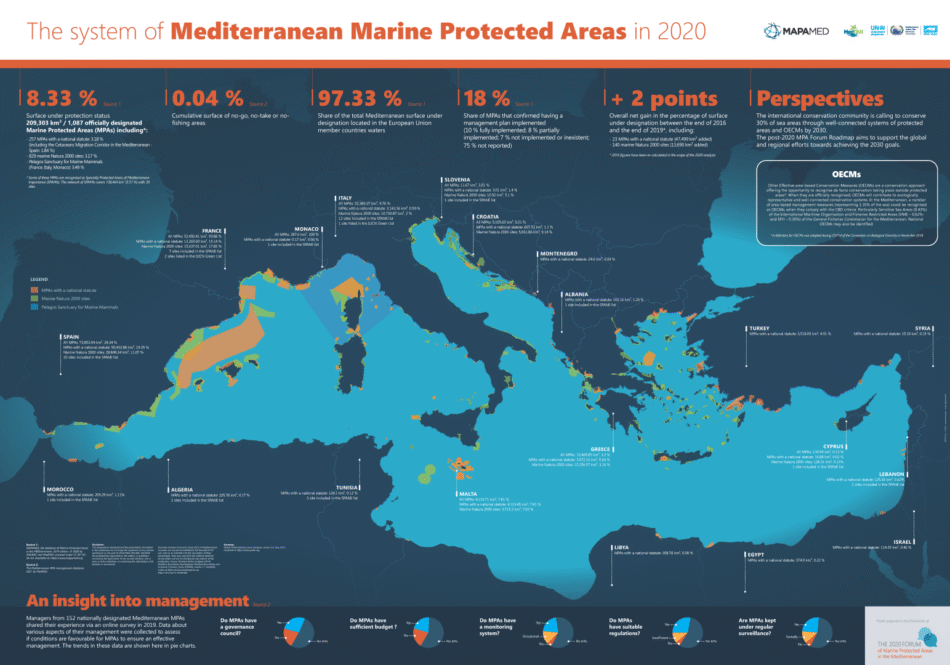
Reading: this map shows that the importance of MPAs is low overall in the Mediterranean; the gap in protection between the north of the Basin (Ponant, Gulf of Lion, Liguria, Adriatic, Aegean Sea) and the south is obvious, with the exception of a few islands in the Gulf of Gabès.
Source: MedPAN.
As part of the United Nations Convention on Biological Diversity (CBD), signed in 1992 at the Rio de Janeiro Earth Summit, and thanks to the 15th United Nations Conference on Biodiversity in Kunming-Montreal (COP15, 2022), an effective conservation target of 30% of land and oceans by 2030 has been agreed. In the Mediterranean, regional players have endorsed this strategic objective, with the Principality of Monaco in particular pledging to encourage the achievement of this target by relying on its moral authority and the work and commitment of its institutions, in line with the conservation steps taken with other neighbouring states in the past, such as the one that created the Pelagos sanctuary.
Three scenarios for public action to protect Mediterranean biodiversity
In the light of these observations, and given the international community’s stated desire to do better in terms of protecting biodiversity, three scenarios for public policy, with concrete courses of action, could be explored in the Mediterranean in order to assess the scope for what is possible and evaluate their impact on the environment.

Scenario 1. Business as usual
Although 8.3% of the Mediterranean is covered by MPAs, its flora and fauna continue to deteriorate. Indeed, even in recognised MPAs with defined protection measures, the effectiveness of controls remains questionable. Despite efforts to limit traditional pollution, the issue of protecting marine waters remains problematic throughout the Mediterranean basin. In Europe, many countries are struggling to protect their coastal waters effectively, and some marine protected areas are still facing pressure from industrial fishing and human activities.
Added to this is the growing need for fresh water, which has led some countries to develop desalination plants. These plants, which extract salt from seawater, discharge massive quantities of brine back into the sea, increasing the pressure on coastal ecosystems. The situation is all the more worrying in regions such as the Alboran Sea, the Gulf of Gabès and the Levant Sea, where protection remains limited due to political constraints and increasing water stress caused by global warming.
If this trend continues, there will be serious consequences for marine biodiversity and the resilience of ecosystems. Coordinated action between Mediterranean countries is therefore essential to preserve these vital ecosystems and meet the challenges of water and climate security.
Scenario 2. Compliance with basic international biodiversity commitments
The international community achieves the target of 30% MPAs by 2030, with a significant contribution from the countries on the northern shore of the Mediterranean. However, although this region has exceptional biodiversity, the benefits for marine biodiversity are likely to be limited if levels of protection and monitoring remain insufficient.
In the North, although the European Union has promoted the Green Pact and supports MPAs, implementation on the ground remains uneven. Some MPAs, including those in France, lack strict regulations and sufficient resources to ensure genuine protection, which means that they are sometimes little more than “partially protected marine areas” (PPAs).
In the south, the situation is often even more complex, with MPAs struggling to provide a real level of protection due to limited capacity and increased socio-economic pressure. In this context, the over-exploitation of natural resources and pollution, particularly through intensive desalination practices, continue to exacerbate environmental pressures (see the work of the Blue Plan, 2024).
In order to go beyond the framework of MPAs and move towards effective protection of MPAs throughout the Basin, North-South cooperation is essential. This cooperation could focus on capacity building, sustainable financing and the sharing of best practices, in order to implement conservation measures that are truly effective and adapted to the specific challenges of each shore.

Scenario 3. Strengthening biodiversity law through general maritime law
Given the ecological richness and particular vulnerability of the Mediterranean, the international community is adopting an integrated approach to reduce the pressures on its ecosystems, without turning it into a sanctuary inaccessible to human activities. Rather than aiming for total restrictions, a combination of legal instruments is being activated to relieve the pressure and slow down time, in order to preserve biodiversity, particularly large marine fauna.
Under the aegis of the International Maritime Organisation (IMO), a Particularly Sensitive Sea Area (PSSA) covers the entire Basin, requiring ships to reduce speed to around 10 knots in areas where cetaceans are present, to reduce the risk of collision and noise pollution. At the same time, the imminent introduction of a Sulphur Emission Control Area (SECA) limits the discharge of atmospheric pollutants, reducing the impact of maritime transport on marine and human health. These maritime initiatives are part of a wider framework of maritime spatial planning, aimed at better management of human activities, from fishing to tourism, while strengthening MPAs and partially protected areas (PPAs), which require increased regulations and surveillance resources.
This framework extends beyond the PSSA and the SECA zone, and reflects a forward-looking vision: that of a global and evolving maritime law, applied not only to the regulation of maritime transport, but also to the management of MPAs and sensitive marine areas. This integrated “100% healthy” approach represents a collective effort to ensure the resilience and sustainable preservation of Mediterranean ecosystems in the face of the many threats they face, from climate change to the impact of human activities.
On the eve of this Year of the Ocean and at the very start of a multiannual programme dedicated to the Mediterranean, supported by Monaco and its institutions, as well as by the Blue Plan, we have the opportunity not only to hold on to the minimum target of 30% of MPAs by 2030, but also to aim for excellence in preserving the biodiversity of the Mediterranean. Its exceptional nature undoubtedly deserves better than the average, which is why the Monaco Oceanographic Institute wants to take action and show the way to a new ambition. Because the Mediterranean is worth it.
——————–
N.B.: this article has been translated from French by DeepL, and revised by the author and Futuribles.
-
An ecotone is an ecological transition zone between two ecosystems. ↑
-
According to the IUCN, a marine protected area is “a clearly defined geographical area, formally recognized, dedicated and managed through legal or other effective means, aiming to ensure the long-term conservation of nature, and of the ecosystem’s services and cultural values associated to it”. ↑