Since 1997, the Millennium Project — a global participatory think tank established in 1996, under the American Council for the United Nations University, which aims to improve humanity’s prospects for building a better future — has regularly published a report entitled The State of the Future, which is a benchmark in the world of foresight. Futuribles has referred to it on several occasions in the past, and returns to it for the 20th edition published in September 2024.
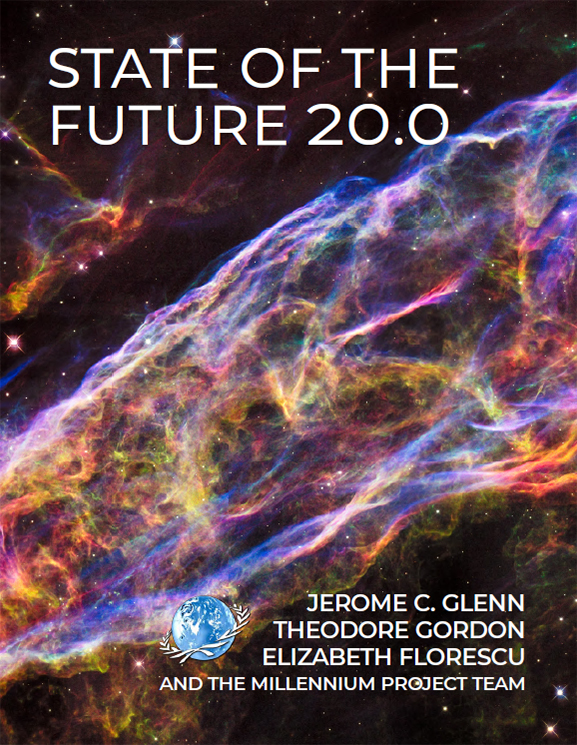
Glenn Jerome C., Gordon Theodore and Florescu Elizabeth (eds.) / The Millennium Project, State of the Future 20.0, New York: The Millennium Project, September 2024, 500 p.
Entitled State of the Future 20.0, this latest opus is still intended to offer a broad and detailed overview of the challenges and opportunities facing humanity in the years ahead, with the idea that by being well informed, we will be in a better position to prepare ourselves and avoid the worst, or even promote the best for our future. This is the aim of many futurists and think-tanks, such as Futuribles.
The Millennium Project has drawn on its network (more than 70 offices around the world) and its many internal studies, as well as the views of hundreds of international futurists and experts. Its stated ambition is to bring to light the prospects for our civilisation, in seven major parts:
- The first presents the 15 global challenges that have been identified (via Delphi studies): sustainable development and climate change; clean water; population and resource; democratisation; global foresight and decision-making; artificial intelligence (AI) for everybody; the gap between rich and poor; health issues; education and learning; peace and conflict; the status of women; organised crime; energy; science and technology; and global ethics. Each theme includes a brief presentation, a list of actions and regional observations.
- The second is entitled “State of the Future Index 2035” and is based on 29 variables to determine whether the future looks better or worse; it also specifies the areas in which humanity may win or lose. In this edition, the experts remain optimistic and are banking on the continued improvement in human living conditions.
- “Governing the Transition from Artificial Narrow Intelligence (ANI) to Artificial General Intelligence (AGI)” presents the views of 55 of the world’s leading experts on general artificial intelligence (AGI) on 22 issues relating to its future, and identifies 40 national and international regulations and five governance models for this AI, assessed by an international panel of 299 members.
- “Beneficial AGI Competition” is about the world in 2045, its problems and opportunities, based on a scenario of a typical day in 2045 and how AGI could, in the authors’ view, significantly improve quality of life by then.
- The fifth part provides an international assessment of the five elements of foresight in the UN Secretary-General’s Our Common Agenda report, which aims to improve the role of the United Nations in the future.
- “World Futures Day” is a summary of the 11th World Futures Day, an open discussion on the future held on 1st March 2024 for 24 hours non-stop across the world, looking back at the trends and patterns identified in previous editions of the World Futures Day.
- Finally, the last part, “Robots 2050”, illustrates the future possibilities that AI robots could offer for governments, everyday life, in bed, in the oceans and in space.


An executive summary of State of the Future 20.0 is freely available on the Millennium Project website; the report is presented in English and available for sale at this link.
——————–
N.B.: this article has been translated from French by DeepL, and revised by the author and Futuribles.