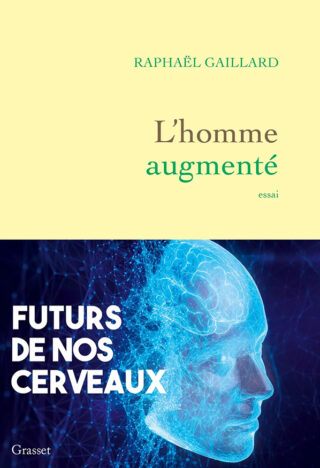
Artificial intelligence (AI) is very much in the news. Its recent achievements have created fascination and concern, including in Silicon Valley. Elon Musk has set up the company Neuralink to develop a brain-machine interface, arguing that this is the only way to avoid domination by machines. The author of L’Homme augmenté. Futurs de nos cerveaux [Augmented Humanity: The Future for Our Brains], Raphaël Gaillard, is particularly well placed to analyze the issue of AI and Musk’s proposed solution. As a psychiatrist, he knows about disruptions to the functioning of the brain and as an academic he has a history of notable publications. In addition, his writing is very clear and satisfying, as befits a graduate of the ENS (École normale supérieure).
Brain-machine hybridization is explored from various angles: the opportunities offered by scientific advances, the potential impacts of this transformation, and the ways in which the impacts might be mitigated. Part one, dealing with the opportunities, is the longest, since there has been much spectacular progress in this area. Repairs to nervous system damage, in the form of loss of limb mobility, verbal expression, and memory, provide a starting point. Successful trials indicate astonishing outcomes: the brain assimilates the implanted prosthesis, a result that bodes well for the future. The author underscores the continuum between repairs, which are car