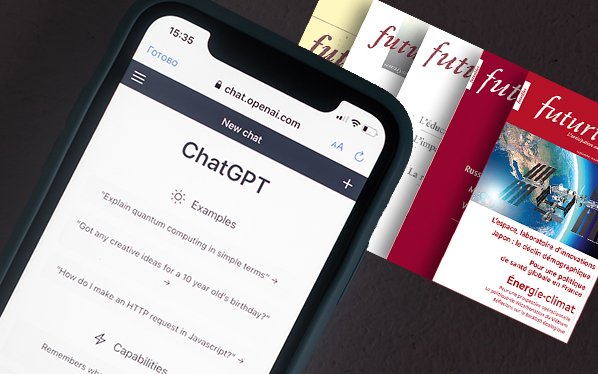
This 50th anniversary of Futuribles has provided an opportunity for us to make a general appraisal of the themes that have received attention since the journal was created. This is an enormous undertaking for a multidisciplinary periodical for which, by definition, no subject is off-limits. Part of this memory work has fallen on our team (this is particularly true of the opening article by Hugues de Jouvenel, founder and editor-in-chief) and on certain contributors who have been associated with Futuribles for many years, whose articles offer insights into it in this issue (Julien Damon and Alain Parant, for example). But it also occurred to us that it might be interesting, as a foresight publication, to employ more modern tools (including artificial intelligence [AI]) to assess what analysis they might make of our editorial corpus.
It has fallen to Juliette Guilbaud to tackle this exercise in exploiting our tables of contents from 1975 to 2025, using generative AI and other text analysis tools. In this article, she outlines how the exercise was conceived and executed, the method employed, and the results obtained. She shows how these tools can make it easy to explore a corpus of this kind (more than 2,500 articles), but also how human intervention still remains indispensable for refining the work, correcting biases and using these technologies to best effect in an exercise of this type. We have retained only selected extracts from the analysis produced by ChatGPT to illustrate this, complemented by some illustrations (mainly word clouds) showing the variety of themes and how they have changed over time. Lastly, we asked AI to focus on two subjects treated regularly since Futuribles was launched: on the one hand, political ecology and the environment and, on the other, demographic ageing. This recourse to AI and the way it proved necessary to ‘interact’ with it enable us, as Guilbaud remarks at the end of her article, to appreciate the pertinence and usefulness of these tools, but also to see their limits and how human hands and eyes are still needed to obtain useable results from them. A relatively reassuring conclusion for a periodical that continues to call on the brainpower of very real authors to assist its readers in understanding the world of the future…
The article is downloadable only in French. It is not available in English.


