In January 2025, the French Treasury published the final version of its report on the economic challenges of the transition to carbon neutrality, an in-depth analysis of the economic consequences of decarbonisation. According to the report, the low-carbon transition in France represents a challenge of surmountable scale and moderate duration for economic growth, with significant but manageable effects on public finances. Above all, the costs of decarbonisation are much lower than those that would result from climate inaction.
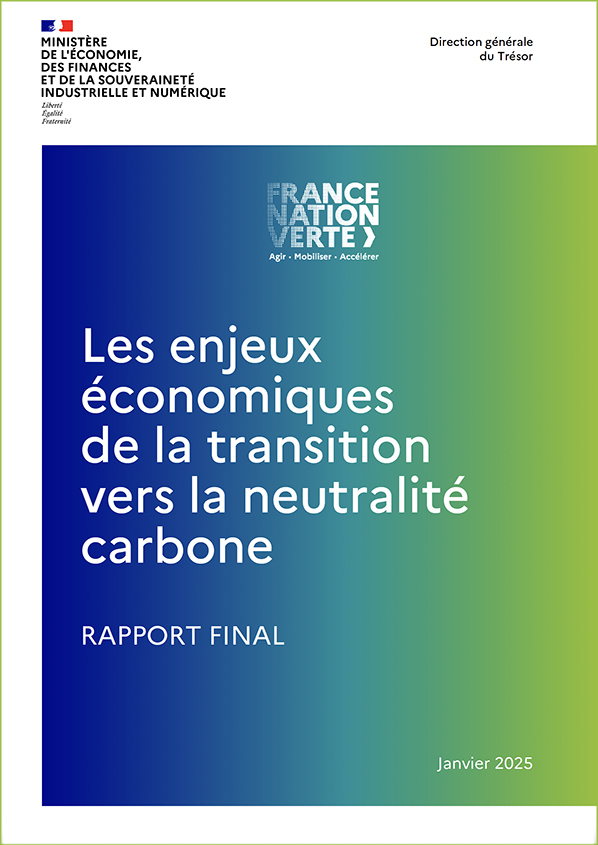
Along the same lines as the Net Zero Review conducted by the UK’s HM Treasury, this report examines the key economic challenges of the transition to carbon neutrality for the French economy. It addresses macroeconomic and sectoral dimensions and outlines the challenges for businesses, the labour market, foreign trade, households and public finances. It draws on analyses conducted as part of the government’s ecological planning strategy, economic literature and analysis of available data, and draws lessons from international comparisons to identify best practices and potential pitfalls to be avoided in the transition to climate neutrality.
In the long term, therefore, climate change mitigation policies bring benefits compared to a scenario of inaction (no cost of avoided disasters, productivity gains from low-carbon technologies, improved security of supply and energy sovereignty, better quality of life and health, etc.). To achieve this, however, we need public policy leadership and a substantial financial effort: the additional investment needed to achieve carbon neutrality is estimated at €110 billion by 2030, compared with 2021 (see graph below).


Additional climate investment needs in the French national long-term decarbonisation strategy in a provisional AMS scenario* (in billions of euros per year)

*AMS: absence de mesures supplémentaires / absence of additional measures.
Source: summary slides presenting the report, DG Trésor , p. 10.
The report sets out the reasons why incentivising public action is necessary, and stresses the importance of international coordination on climate issues to mitigate the costs of the transition. Given the state of public spending in France, a large part of the investment must come from the private sector (the report offers a comparative table of sustainable finance instruments). The authors then show that the transition has very different effects on different households (depending on their income, where they live etc.) and list a series of targeted support and financial aid measures.
Another key point is that the French manufacturing industry has succeeded in decoupling its greenhouse gas emissions from its production, and is ahead of the rest of the world in terms of decarbonisation. Finally, several thematic or sectoral chapters are proposed (further decarbonisation of the energy system, transport, agriculture, housing, challenges in terms of jobs, public finances, further adaptation, etc.).
The presentation document (available in English, 75 p.) provides a fine overview of all the economic issues involved in the transition. And for a more detailed, highly detailed analysis, the full report (only in French, 260 p.) is a mine of information; an executive summary in English can be downloaded.

Reference: Les Enjeux économiques de la transition vers la neutralité carbone, Direction générale du Trésor, January 2025, 260 p.
——————–
N.B.: this article has been translated from French by DeepL, and revised by the author and Futuribles.