Alexis Paillet is preparing Human Spaceflight exploration thanks to Spaceship France project. The ambition of the Spaceship network, initiated by the European Space Agency (ESA) in 2012 and supported since 2018 in France by the Centre national d’études spatiales (CNES – French Space Agency), is to contribute to the research and development of some of the key technologies for establishing permanent outpost on the Moon and later on Mars. Valentin Fournel is Director of Eco-design and Reuse at Citeo, a state-regulated eco-organisation set up by consumer goods and distribution companies to reduce the environmental impact of their packaging and paper, by offering them reduction, reuse, sorting and recycling solutions. CNES and Citeo are collaborating to examine the life cycles and recycling of goods and consumables that will be used in future lunar and Martian missions. In this interview, Alexis Paillet and Valentin Fournel outline the avenues that the two organisations are exploring together.
What are the current considerations on the life cycle of objects and recycling within the International Space Station (ISS)? How does this differ from terrestrial constraints?
Alexis Paillet: Currently, there is not much recycling on the ISS, which mainly relies on consumables, whether for food (no in situ production), air and water (which are only partially reused using disposable cartridges), clothing, hygiene products, etc. Astronauts place waste in containers, which are then burnt in Earth’s atmosphere. With the possibility of a resupply mission once a month, this is the most cost-effective solution.
However, we will not have this option for lunar missions, where astronauts might only be resupplied every six months, and even less for Martian missions, where resupply would depend on the optimum launch windows (on average every 26 months). Therefore, it will be essential to turn all these diverse wastes into usable resources: recycling and, by extension, the whole life-cycle approach to onboard objects thus represent a new perspective, which did not really exist for ISS missions.
CNES has therefore consulted industry leaders of eco-design and recycling on Earth, including Citeo, to develop with them the future solutions that will be essential for such missions. There are two key issues in this work: miniaturisation and minimising the required consumption, particularly in terms of energy and water.


Valentin Fournel: The aim of this partnership for Citeo is not to put a giant recycling bin on the Moon, but to use an environment with radically different constraints from those we know on Earth to expand the range of possibilities. We face extreme technical constraints in terms of available resources (energy and water) and space — on the other hand, we can more easily free ourselves from the economic constraints of profitability and optimisation, which are very strong on Earth. Thus we are dealing with a completely different set of constraints, which means we have a new field of research and development to explore, with potential applications here on Earth.
What are the main principles for considering life cycles and recycling in the context of long-distance missions?
V.F.: We need to rethink consumption and usage, beyond recycling. This leads us to ask questions such as “What can or cannot be taken on a manned flight?” and, more broadly, “What will be the essential needs of future inhabitants, during the flight and then on-site?” Ultimately, this leads us to reflect on what is essential, as human beings on Earth, for maintaining physical and mental health.
Once these needs are identified, we consider how to provide the essential functionalities, knowing that the needs during the flight phase are, in part, very different from the needs once on-site. We prioritise developing objects with dual functionalities or at least reusable ones, both for the flight and for life on site. Recycling is the next stage: if an object cannot be reused as it is, we think about how to reuse its materials.
Our order of priorities is as follows:
- Reuse and repurposing, considering the most efficient cleaning processes if necessary.
- Mechanical recycling, especially through 3D printing, after grinding down non-reusable materials.
- Organic recycling, once the material’s mechanical performance is too degraded (biodegradation, fermentation, etc.).
- As a last resort, chemical recycling can be used to transform the material, although this is still a highly energy-intensive process compared to the others (enzymatic degradation, crystallography, pyrolysis etc.).

What pathways are you exploring? What specific challenges and obstacles are you facing?
A.P.: We are working on various topics, always with the challenge of finding the technological niche that can highlight France’s capabilities, compared to avenues already being pursued elsewhere.
For air and water recycling, the overall challenge is to close the loops as much as possible, and therefore to find maintenance solutions without consumables: today, on the ISS, we achieve 80% water reuse and 45% air reuse, using cartridges. For long-duration missions, we need to approach 98% for water and 99,99% or more for air. Regarding air, we are focusing on purification and odour elimination; for water, on eliminating endocrine disruptors. In both cases, there is a dual application for land (such as removing endocrine disruptors from hospitals’ wastewater).
We are also evaluating all the inorganic waste, meaning everything that will be brought on-site. For example, during the flight, it is essential to have anti-vibration foams to protect the equipment, but these become useless once on-site. How can we design materials that have this function at the outset, but can be repurposed later as an organic substrate for 3D printing new objects (which implies being able to transform them into filament), such as furniture, tools, clothing, etc.? To achieve this, we are studying bioplastics, metals, and bio-based fibres. For instance, PHAs (PolyHydroxyAlkanoates), bio-based plastics, are an interesting avenue: produced from food waste using bacteria, they degrade into water and CO2, two exploitable resources.
We are also exploring the use of local resources. On the Moon, there are primarily two resources: the Sun and regolith, which itself contains oxygen, sodium, magnesium, aluminium, silicon, titanium and iron. The challenge is to extract these local minerals to use them to 3D print small objects, with the ultimate aim of replacing the plastic input with these bio-based elements.
Another possibility is to incinerate plastics at the end of their life cycle to produce energy. This requires working on both the processes themselves, mainly to achieve the highest efficiency and calorific value possible, and on the miniaturization of these processes so they can be onboarded.
Another interesting topic to consider is cooking, including the methods and utensils we use. For example, when cooking pasta or rice, we instinctively boil water at 100°C; yet, this temperature is not necessary. The challenge here is to lower this temperature to use less energy, produce less steam, and also to capture the residual steam, perhaps with a special pressure cooker that could redirect this output towards a useful use.
V.F.: The widespread adoption of reusable items and the limited resources available make washing another critical issue, and one where we must minimise water use as much as possible. We are exploring the use of supercritical CO2, which could potentially be used on the Moon to wash containers, perhaps clothes, or even people – especially since CO2 is an available resource on site, if only through human respiration. This would not only save water but also help close the CO2 loop.

The different ways to reuse and recycling and the associated opportunities
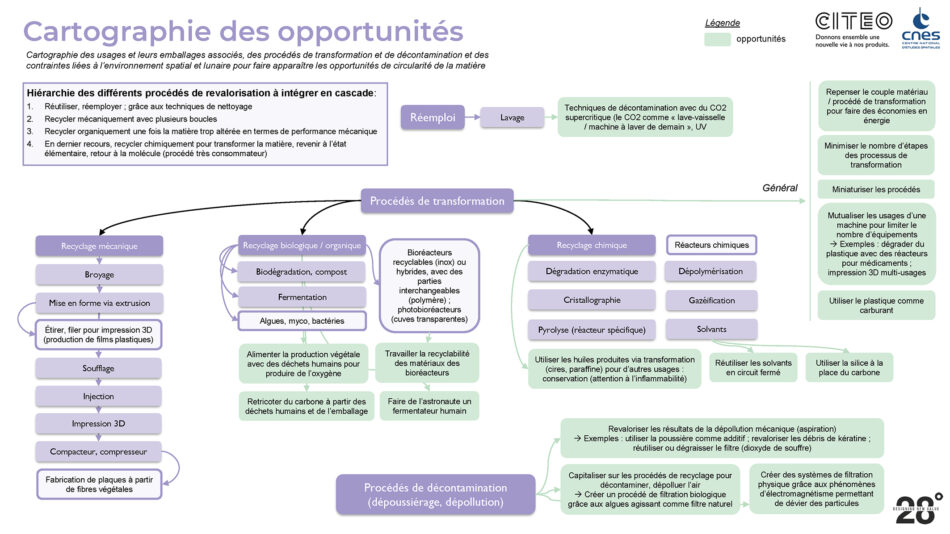
Elements identified following an ideation workshop with stakeholders. Source: Citeo and CNES.
In the long term, what terrestrial applications do you see for the solutions arising from your research?
A.P.: One of the common threads running through our work is the idea of consuming just what we need, an issue that can be directly transposed here on Earth. To achieve this, we are working on cycles (carbon, nitrogen, etc.), with the idea of closing as many loops as possible. On Earth, I believe it is the multiplication of open loops that creates waste, and consequently, excessive consumption.
We are also working on the miniaturisation of processes. This could enable processes on Earth, such as waste incineration to produce energy, to become profitable on a small scale (house, neighbourhood…), eliminating the need for waste transportation.
Similarly, we are working on objects with dual or triple uses for everyday items and, more broadly, on the reversibility of uses — this could open the door to greater sobriety in the consumption of materials and resources needed in everyday life.
In short, our job is to reinvent the daily lives of people who will be living in space tomorrow, and there are many parallels with the daily lives of people living here on Earth!
Interview by Quentin Bisalli
N.B.: this article has been translated from French by DeepL, and revised by the authors and Futuribles.