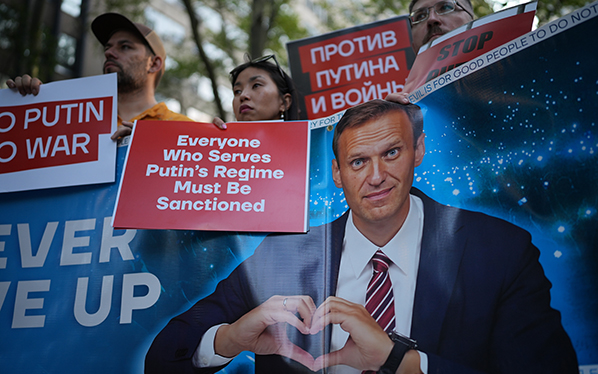
War has already been raging for three years in Ukraine, and it is more than ten since Moscow’s offensive on Ukrainian territory began with the annexation of Crimea in 2014. By Western estimates, the ‘special operation’ (as the Kremlin calls it) launched in February 2022 has already killed between 180,000 and 240,000 Russians and seriously wounded a further 500,000. In a country already greatly weakened demographically, with an economy hit by international sanctions, how is the situation viewed by society? And, most importantly, how can we take the pulse of that society, in which freedom of expression is conspicuously hobbled by its authoritarian regime?
Joris Van Bladel looks into the opinion polls through which Russian society can be probed. He shows that, despite potential self-censorship on the part of respondents, we can, by examining those polls over time, glean some precious clues. In particular, the support expressed for Vladimir Putin’s regime must not be mistaken for deep commitment. The—direct or indirect—responses, when cross-referenced with the trends observed in more classical areas of investigation, reveal a Russian society under tension, resigned, cautious and fragmented: a society that is beginning to weary. The opinion studies carried out in Russia serve less to predict the positions of Russian society than to underscore its fragilities, unpredictability and, hence, potential openness to radical change, were future shock events to occur. As Joris Van Bladel sees it, an awareness of this unpredictable character is crucially important for external observers, enabling them to avoid being totally surprised by how Russian society may behave in the medium term.
The article is downloadable only in French. It is not available in English.