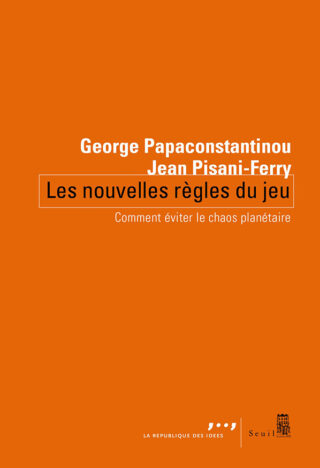
In today’s context of global crises and challenges (in particular climate change), how and by what means can we “govern” the world? This book by George Papaconstantinou, a professor at the European University Institute in Florence, and Jean Pisani-Ferry, a researcher at the Bruegel think tank in Brussels,[1] attempts to answer these questions.
Papaconstantinou George and Pisani-Ferry Jean, Les Nouvelles Règles du jeu Comment éviter le chaos planétaire, Paris: Seuil (La République des idées), 2024, 144 p. [translation: New World New Rules: Global Cooperation in a World of Geopolitical Rivalries. Newcastle upon Tyne: Agenda Publishing, 2024, 192 p.]
“Governing the world” is a recent idea that emerged in the aftermath of the two world wars. After the failure of the League of Nations, which was created in 1919, the Bretton Woods economic, monetary, and financial system was introduced in September 1944, with the International Monetary Fund (IMF) and the World Bank. The aim was to fund the postwar reconstruction effort, and the system laid down restrictive ground rules. The creation of the United Nations (UN) in October 1945, then its agencies (including UNESCO, the WHO, and the FAO),[2] and the establishment of the World Trade Organization (WTO) in 1995 completed the system. This global governance consecrated the supremacy of the US dollar and the influence of the Western countries in international organizations.
Collective international action relies on a legal requirement for states to follow the rules (or face sanctions), but it is also dependent on the economy and the nature of international relations. Economists think that incentives to cooperate are the most usef